- Get link
- X
- Other Apps
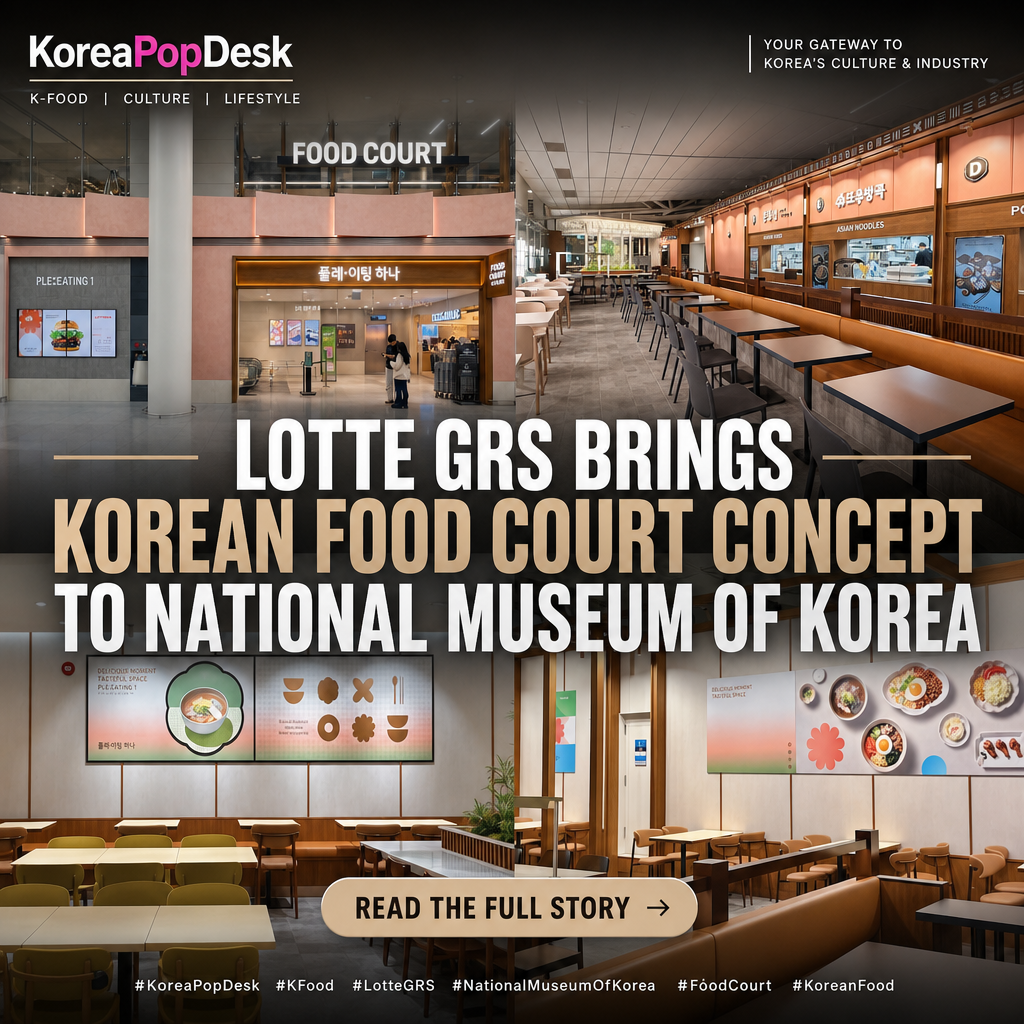
Visitors to the National Museum of Korea now have a new dining option designed around the setting of one of Seoul’s major cultural destinations.
Lotte GRS, the restaurant company behind brands including Lotteria, announced on July 20 that it had opened a food court described in Maeil Business Newspaper’s English report as the “Korean Food Museum.” The venue places familiar Korean dishes within the museum while also offering Chinese and Western food.
What visitors can find inside
The food court is located on the first floor of the museum’s exhibition building in Yongsan-gu, Seoul. A later Maeil Business report described it as an approximately 275-pyeong space with 316 seats.
Its sections cover bibimbap, soups, snack foods, Chinese dishes, Western dishes and chicken. The opening report specifically identified tteokbokki and bibimbap among the Korean foods available.
Menu items developed for museum visitors include a yukgaejang and tteokgalbi meal set and a five-color ssamjang meal set, according to the follow-up report. Traditional colors were also incorporated into the interior to reflect the food court’s location inside the museum.
The format therefore differs from a narrowly focused restaurant or exhibition café. It combines recognizable Korean meals with broader food-court choices for museum visitors with different dining preferences.
Background: Lotte GRS moves beyond transport hubs
Lotte GRS presented the opening as part of an effort to strengthen its concession business. The company’s stated strategy is to enter cultural destinations rather than concentrating only on locations such as airports and railway stations.
The food court is not the only dining operation being shaped around the museum environment. Maeil Business reported in August that Ediya Coffee had operated five cafés at the museum since March. Those locations use an “Five Commas” concept and offer coffee, tea and desserts in spaces intended for breaks during a museum visit.
Ediya also developed items connected to traditional imagery and ingredients. The report identified a red-and-blue signature iced tea inspired by a royal garment associated with Crown Prince Yeongchin and signature lattes made with black sesame.
Together, the openings show restaurant operators adapting menus and interiors to the identity of the museum rather than reproducing a standard branch without changes.
Why it matters for international visitors
For overseas travelers, the new food court places Korean dining inside the same visit as the museum’s collections and exhibitions. Visitors do not have to leave the complex to find dishes such as bibimbap, tteokbokki or Korean-style meal sets, while mixed menus remain available for groups seeking other choices.
The business consequence is also specific: Lotte GRS is testing a concession model in which a cultural venue serves as both a sales location and a place to introduce the company through food and design. The company said it plans to continue developing food-and-beverage operations tailored to different commercial districts.
A food-industry representative quoted by Maeil Business said the museum reaches a broad range of customers, from families to foreign tourists. The representative expected companies to remain interested in spaces that combine cultural content with food-and-beverage experiences.
That approach could make museum dining a more deliberate part of the visitor experience rather than simply a practical stop between exhibitions. In this case, the National Museum of Korea provides the cultural setting, while Lotte GRS uses Korean dishes, dedicated menu items and traditional visual elements to shape the food court around its location.
Sources: Maeil Business Newspaper — Lotte GRS opening report; Maeil Business Newspaper — National Museum restaurant follow-up.
Comments
Post a Comment